
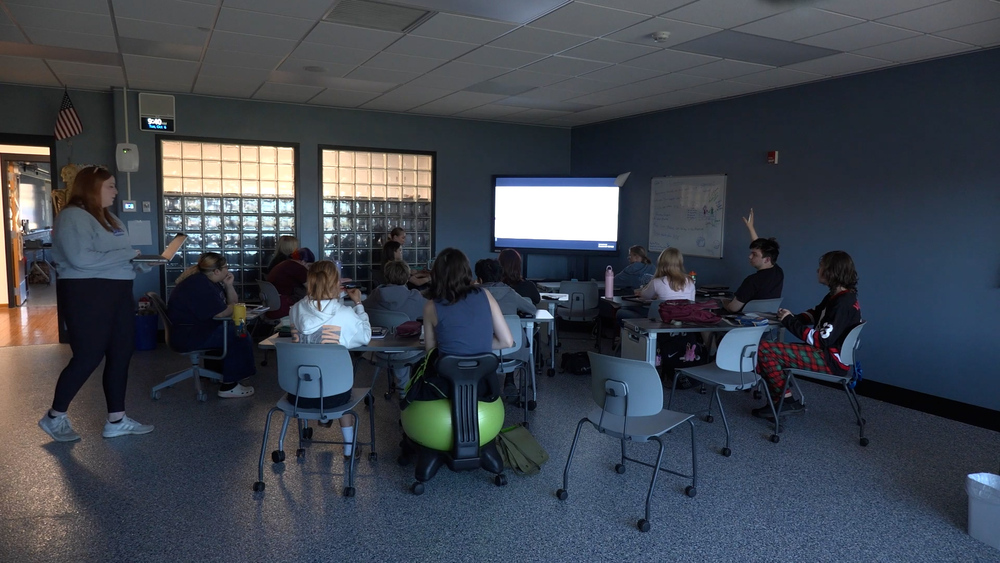
For generations, the conventional high school experience has been defined by 40-minute class periods, rows of desks, and standardized lectures. But at the Frontier Big Picture High School, a non-traditional program within our own Frontier Central School District, educators and students are proving that learning does not have to be confined to a classroom.
Part of the national Big Picture Learning network, the academy offers an individualized, student-centered approach designed for those who may not thrive in a traditional environment. While students still earn a standard New York State Regents diploma by meeting identical state credit and exam requirements, they do so by building customized learning plans around their personal passions and spending every Tuesday and Thursday out in the community through specialized internship programs.
The High School reached a historic milestone this past June when it celebrated its very first full graduating class of students who spent all four years in the Big Picture program.
"Watching the journey of students... was so incredibly heartwarming," said Danielle Kalinski, principal of Big Picture High School, who is known affectionately by her students as Mrs. K. "Differently from a traditional school where teachers teach a 40-minute course, these teachers are also advisors for these students. They’re really invested in what their personal goals, their social goals, and their life goals are."
Kalinski noted that the program serves a wide range of students, from those who are disengaged from learning because a traditional school feels too large, to students who want to hone a hyper-specific passion. It also acts as a real-world testing ground before families pay for higher education.
"College is expensive today. Trade schools often cost something, too," Kalinski said. "Sometimes kids have in their mind that they want to do something, but they haven’t actually been in and felt what it feels like to be in that space. Big Picture gives them the opportunity to actually be there, to try it, to feel what it feels like."
For the students enrolled, the real-world exposure has completely transformed their relationship with education.
Abigail Stayoch, a junior who has been with the academy since her freshman year, recalled facing negative stereotypes when she first chose to enroll.
"When I was an eighth grader, I expected it to be very different than it is," Stayoch said. "Because going into it, we had a stereotype… and all my friends were like, 'Why are you going there? That’s not where you should be going.' And then when I got here, I was like, this makes school enjoyable. It makes it fun."
Stayoch’s hands-on journey included helping to launch the school's own student-run coffee shop as a freshman, working at an animal shelter as a sophomore, and spending her junior year interning at a local bookstore to learn entrepreneurship from a small business owner. The program also helped her rule out a career path: an independent study in interior design taught her that while she liked the subject as a hobby, she didn't want it as a job.
Beyond career clarity, students credit the program with dramatic personal growth and skyrocketing attendance rates.
"In middle school, I couldn't even stand up in front of my class and do a presentation, and now I can talk on a camera and talk to grown-ups," Stayoch said, adding that her chronic middle school absences dropped to fewer than 10 total across her first two years at the academy.
Jiana Kiddy, a senior who has also been at the school since her freshman year, shared a similar transformation. After an internship at a hair salon made her realize the beauty industry wasn't a perfect fit, she transitioned to an early childhood placement where she fell in love with the work.
"I have changed so much since freshman year," Kiddy said. "Freshman year, I never came, I had no motivation to go to school at all. But this year and last year, I definitely worked on my attendance a lot... It definitely helped me change my perspective on people. Everyone's different here. So we all learn from each other and it helps you actually work on yourself more."
According to school leadership, the local business community has embraced the model enthusiastically, frequently requesting more student interns once an internship concludes.
When asked what they would tell a student considering applying to the program, the students' answers were unanimous.
"I’d say yeah, I would say yes," Stayoch said. "It has made school so much more enjoyable for me. Like, I actually want to be here."
Watch our video here: 🎥 Beyond the Classroom: How Frontier’s Big Picture HS Transformed the High School Experience