
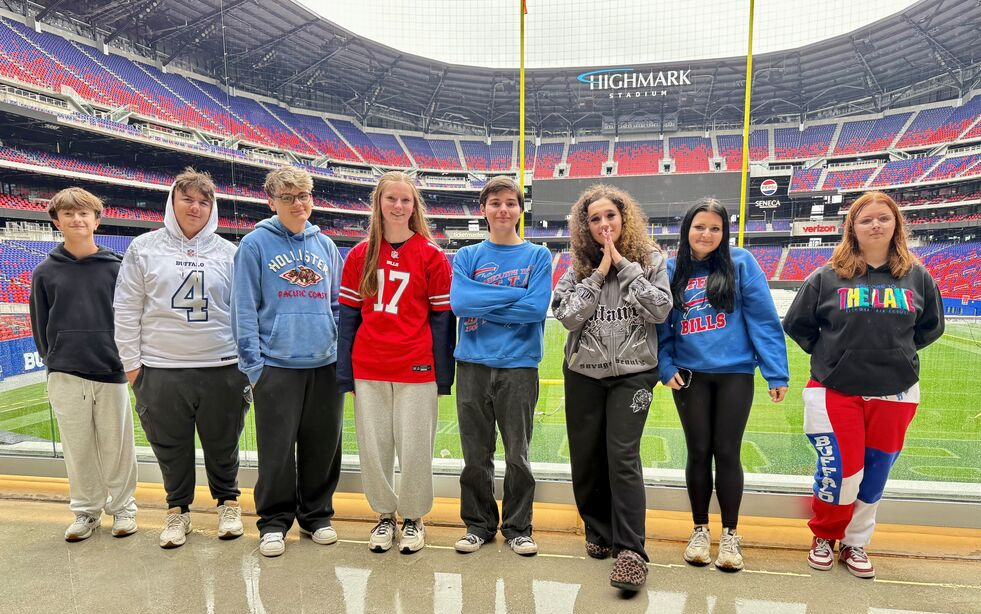
Interior design students from Frontier High School recently took a specialized STEAM tour of the new Highmark Stadium to study how local history, public art, and architectural engineering converge in modern sports venue design.
Led by art educator Nicole Beyette, students from the high school's Interior Design I and II classes explored the 60,000 seat facility. The field trip allowed students to see how structural and aesthetic choices transition from classroom concepts to a massive community space.
"We are always talking about art in spaces and how art makes us feel," Beyette said, noting that her students apply these principles while designing their own dream homes and managing project expense sheets throughout the school year. "To connect the Buffalo connection to a place that's so meaningful to our community as a whole with the sports, was really great for them to see."
The tour highlighted how the stadium's design firm, Populous, intentionally incorporated Buffalo’s identity. Architects chose iron-spot brick to anchor the building and used the stadium's structural crossbeams as storytelling opportunities to honor the city's rich steel-making heritage.
Students also observed how designers used texture and materials to balance the stadium's industrial bones. Beyette pointed out that hard metal elements were sprayed with textural coatings, while other areas featured smoother materials like paint, stone, resin, and marble inside the team locker rooms.
"I hope that the students were listening and heard that those decisions were made specifically to represent different areas of the stadium and how we feel in it," Beyette said.
A major focal point of the tour was the Buffalo Bills Public Art Program, an initiative bringing together more than 45 artists to create permanent, site-specific installations throughout the venue. The artwork is designed to soften the heavy steel elements and make the open-air environment feel inclusive and culturally connected.
The students witnessed firsthand how recurring visual motifs, like the forward-moving "charge" stroke from the Bills logo, link the architecture, interior graphics, and custom lighting fixtures such as a central chandelier featuring nearly 2,000 suspended acrylic pieces.
The experience provided the young designers with real-world context for their future projects, proving that even a massive football stadium can feel like a curated, meaningful home for its community.